
- Posted on
- • Finance
Dow Hits 52,000 for the First Time: What It Means for Investors
- Author
-
-

- User
- iamhamzatahir
- Posts by this author
- Posts by this author
-
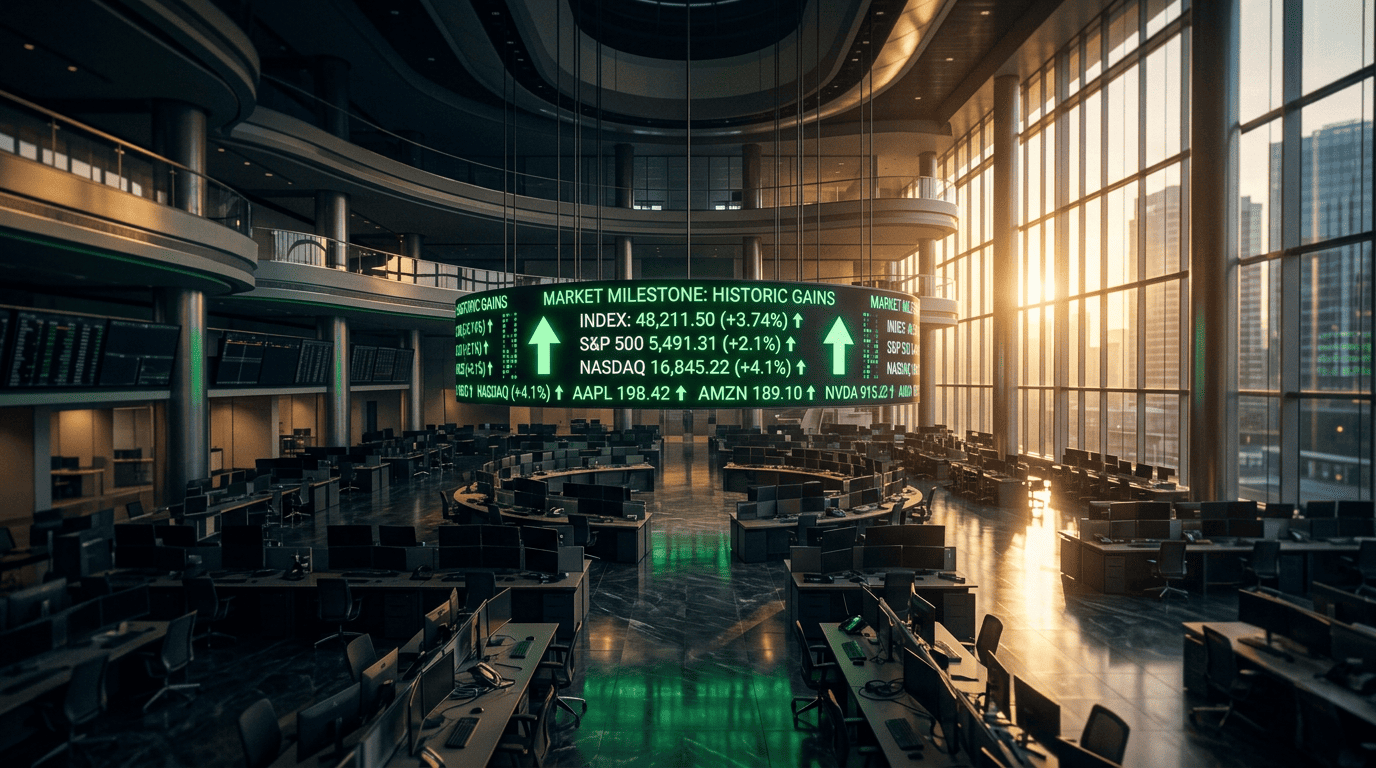
On Monday, June 29, the Dow Jones Industrial Average closed above 52,000 for the first time ever. That alone would be headline-worthy. But what made this session genuinely unusual wasn't just the number — it was how many unrelated forces had to line up at the same moment to push it there.
Alphabet officially joined the Dow. Tesla surged 8% on a single software update. The Supreme Court protected the Federal Reserve's independence. And a fragile ceasefire between the United States and Iran held through the weekend, calming oil markets. Four separate stories, all breaking bullish on the same trading day.
That kind of convergence doesn't happen often. And when it does, it's worth understanding what actually drove it — and what it means for your portfolio heading into a holiday-shortened week with a jobs report on deck.
The Historic June 29 Session: Dow Jones 52,000 and Beyond
The Dow gained 306.63 points, finishing at 52,182.74 — a 0.59% move that sounds modest until you zoom out. This was the index's fourth 1,000-point milestone of 2026. It closed above 51,000 just 18 trading days earlier. Back on February 6, the Dow crossed 50,000 for the first time. Four months later, it's tacked on another 2,000 points — roughly a 4% gain from an already historic level.
The S&P 500 climbed 1.18% to 7,440.43. The Nasdaq Composite led the pack, rising 2.07% to 25,820.14, powered by a broad tech rally that saw the VanEck Semiconductor ETF gain more than 3%. Astera Labs jumped about 16%, KLA rose roughly 12%, and Applied Materials gained nearly 11%.
Here's the thing about round numbers: 52,000 has no mathematical significance. Markets don't care about zeroes. But traders and algorithms do. The Dow had actually traded above 52,000 on multiple occasions in prior sessions but kept getting pulled back below that line by intermittent volatility. Monday was the first time it held through the closing bell.
Some of that late-session strength may have come from quarter-end window dressing — a well-known practice where portfolio managers buy strong performers right before a quarter closes so their holdings look better in client reports. It's not exactly a secret, but it does add real buying pressure at the margins.
Alphabet Joins the Dow: What This Means for Index Fund Investors
Alphabet shares rose 3.7% to $350.24 on Monday as the Google parent company officially began trading as a Dow component, replacing Verizon Communications. S&P Dow Jones Indices had announced the swap on June 23, citing Alphabet's broader business portfolio — spanning advertising, cloud infrastructure, AI, hardware, autonomous vehicles, and healthcare technology — as a stronger representation of the Communication Services sector than Verizon.
Why does this matter beyond symbolism? Because the Dow is a price-weighted index. That means a stock's influence on the index depends on its share price, not its market capitalization. Verizon's relatively low share price meant it accounted for only about half a percentage point of the entire benchmark. Alphabet, trading near $350, immediately became one of the most influential members of the 30-stock index.
If you own a Dow-tracking fund — like the SPDR Dow Jones Industrial Average ETF (DIA) — your portfolio now holds Alphabet instead of Verizon. That's a meaningful shift in sector exposure, swapping a legacy telecom company for one of the largest digital advertising and cloud computing businesses on the planet.
Five of the seven "Magnificent Seven" tech stocks now sit inside the Dow: Alphabet, Nvidia, Amazon, Apple, and Microsoft. I've been watching index composition changes for years, and this one feels less like a surprise and more like the Dow finally catching up with reality. The index has always been a lagging indicator of where economic power actually lives. Apple wasn't added until 2015, years after the iPhone had already reshaped how we work and communicate. Goldman Sachs joined in 2013, well after the financial crisis had proven the financial sector's systemic importance.
Verizon, meanwhile, dropped about 5% on Monday after the removal was made official. Being dropped from a major index triggers forced selling from passive funds, and that pressure can linger for days.
Why Tesla Surged 8% in a Single Day
Tesla rallied 8.4% to close at $411.84 — its biggest single-day gain in over a year. The catalyst wasn't a new vehicle announcement or a blowout earnings report. It was a software update.
Specifically, Tesla released FSD v14 Lite, a new version of its Full Self-Driving software designed for older vehicles running Hardware 3 (HW3) chips. These are cars sold from roughly 2019 onward that had been stuck on FSD version 12.6 since early 2025 — more than 14 months without a meaningful upgrade. Newer Tesla models had already moved to version 14, gaining features like automatic parking and gear-shifting, leaving older owners feeling left behind.
Ashok Elluswamy, Tesla's VP of AI, announced the rollout on X, emphasizing improved safety and better hardware compatibility.
Why did Wall Street care so much about a software update for older cars? Two reasons.
First, retention. Delivering a real upgrade to existing owners — without requiring them to buy a new vehicle — signals that Tesla can keep its installed base engaged. Imagine you bought a Tesla in 2020 and watched newer owners get features you couldn't access. You'd feel forgotten. This update changes that calculus.
Second, recurring revenue. Every owner who gets excited about improved self-driving capability is a potential subscriber to Tesla's $99-per-month FSD service. That's high-margin, recurring income that doesn't depend on selling another car. Wall Street loves subscription revenue, and for good reason — it's more predictable and more profitable than one-time hardware sales.
The rally also got a boost from rising Q2 delivery expectations. Morgan Stanley raised its estimate to around 413,000 vehicles, Barclays projected roughly 418,000, and Goldman Sachs came in near 420,000. All three sit above Tesla's company-compiled consensus of about 406,000 deliveries. Those numbers are due later this week, and they'll be the next real test for the stock.
A word of caution, though: Tesla is still down about 6% since June began and roughly 8.4% year-to-date. One great day doesn't erase months of concern about EV demand, pricing pressure, and a valuation that still demands a lot of future growth to justify. I'd watch the delivery data closely before drawing any big conclusions.
The Supreme Court Ruling That Protected Your 401(k)
This was arguably the most important story of the day for long-term investors, even if it got less attention than the Dow milestone or Tesla's pop.
The Supreme Court ruled on Monday that Federal Reserve Governor Lisa Cook would remain in her position, rejecting the Trump administration's attempt to fire her. The court did expand presidential authority to dismiss officials at other independent agencies, but it carved out a specific exception for the Federal Reserve.
Why does this matter so much? Because global financial markets depend on the Fed operating independently from political pressure. Under the Federal Reserve Act, presidents can only remove governors "for cause" — meaning evidence of actual wrongdoing. No president has ever successfully fired a top Fed official. This ruling reinforced that precedent.
Think about what's at stake. If a sitting president could fire Fed governors whenever monetary policy decisions didn't align with political goals, interest rate decisions would become politicized overnight. Bond markets would lose confidence in the Fed's inflation-fighting credibility. Mortgage rates, corporate borrowing costs, the dollar's value as a global reserve currency — all of it rests on the assumption that the central bank makes decisions based on economic data, not election cycles.
The market's reaction was immediate and positive. Stocks climbed, Treasury yields held steady, and volatility measures ticked lower. Investors read the ruling exactly as intended: the institutional guardrails are still in place.
Easing Geopolitical Tensions and Falling Oil Prices
The fourth catalyst was quieter but no less significant. Over the weekend, concerns about renewed hostilities between the United States and Iran had rattled futures markets. But by Monday morning, both sides confirmed they would honor the memorandum of understanding signed on June 17, which called for a cessation of hostilities and the reopening of the Strait of Hormuz to commercial vessels.
WTI crude futures had already settled below $70 on Friday for the first time since late February — the day before the Iran conflict began. On Monday, oil closed at $70.17, up a modest 1.3% but well below the panic levels seen during the worst of the crisis. Lower oil prices act like a quiet tax cut for consumers and businesses. They reduce transportation costs, ease pressure on input prices, and give the Fed slightly more room to hold interest rates steady.
The ceasefire is fragile. I wouldn't bet the farm on it holding indefinitely. But the fact that commercial shipping is moving through the Strait of Hormuz again removed one of the biggest tail risks that had been hanging over markets for months.
What to Watch: Jobs Report and Tesla Deliveries
This is a holiday-shortened week — U.S. markets close Friday for Independence Day — which means the June nonfarm payrolls report lands on Thursday instead of the usual Friday release. Economists expect a gain of around 112,000 jobs, a notable slowdown from last month's 172,000. A weaker number could reinforce expectations for a rate cut later this year. A stronger print might reignite concerns that the Fed will stay on hold longer.
Tesla's Q2 delivery figures are also expected this week. Given the elevated analyst estimates and Monday's rally, the stock is priced for a beat. If deliveries come in below 410,000, the 8% gain could evaporate quickly. If they surprise above 420,000, the momentum trade has room to run.
RBC Capital Markets added fuel to the broader bull case by raising its 12-month S&P 500 target to 8,150 from 7,900, citing earnings strength and a supportive macro backdrop. That implies roughly 9.5% upside from Monday's close — a meaningful forecast from a major bank.
Monday was one of those rare sessions where everything broke right at once. Legal clarity on Fed independence, a geopolitical ceasefire holding, a major index reshuffle, and a software catalyst for one of the market's most-watched stocks all converged in the same direction. Days like this feel good, but they can also create a false sense of security.
The real question isn't whether the Dow can stay above 52,000. It's whether the forces that pushed it there — easing tensions, rising earnings estimates, institutional stability — are durable or temporary. Thursday's jobs report and Tesla's delivery numbers will give us the first real answer. Are you positioned for what comes next?