
- Posted on
- • Finance
SpaceX IPO Valuation: The $200 Secret Behind a $2 Trillion Bet
- Author
-
-

- User
- iamhamzatahir
- Posts by this author
- Posts by this author
-
The Most Expensive Promise in Corporate History
Picture this: a company loses $5 billion in a single year. It's never turned a consistent profit. And yet, investors just handed it $75 billion in the biggest IPO mankind has ever seen, valuing the whole operation at $2 trillion.
Sounds insane, right? That's because it kind of is.
I've been covering tech IPOs for over a decade, and I've never seen anything like this. Not even close. Saudi Aramco held the IPO record for six years with $29.4 billion, but they had something SpaceX doesn't: eighty years of pumping oil and $20 trillion in proven reserves.
SpaceX has losses. Lots of them.
So what gives? Why would the smartest investors on the planet throw trillions at a money-losing rocket company? After digging through hundreds of pages of IPO documents, I found the answer. And it's not what you'd expect.
It all comes down to one tiny number: $200.
Not $2 trillion. Not $75 billion. Two hundred dollars. If SpaceX hits this number, they're the Amazon of 1997. If they miss? This could go down as the biggest bubble ever sold to the public.
Three Companies Pretending to Be One
Here's where things get weird. When you buy SpaceX stock, you're not buying a rocket company. You're actually buying three completely different businesses wrapped into one confusing package.
Business #1: The Rocket Division (The Money Pit)
Yes, you read that right. The most successful rocket company in human history actually loses money on rockets. In 2025, this division brought in $4 billion in revenue and still posted an operating loss. Why? Because they're pouring roughly $3 billion into Starship, this absolutely massive rocket that's designed to do something no other rocket has ever done.
See, the Falcon 9 was already revolutionary. Before SpaceX, every rocket company would launch their rocket, let the first stage burn up or crash into the ocean, and then build an entirely new one for the next launch. It was like buying a brand new 747 for every single flight.
SpaceX changed that. The Falcon 9 comes back. It lands vertically, ready to fly again. They even catch the payload fairings (those protective nose cones) out of the air with giant nets. This dropped launch costs by 85%, from $18,500 per kilogram to $2,700 per kilogram.
But here's the catch: even the Falcon 9 still throws away about 20% of itself on every flight. The second stage either burns up or stays in orbit. That's $12 million, gone forever, every single time.
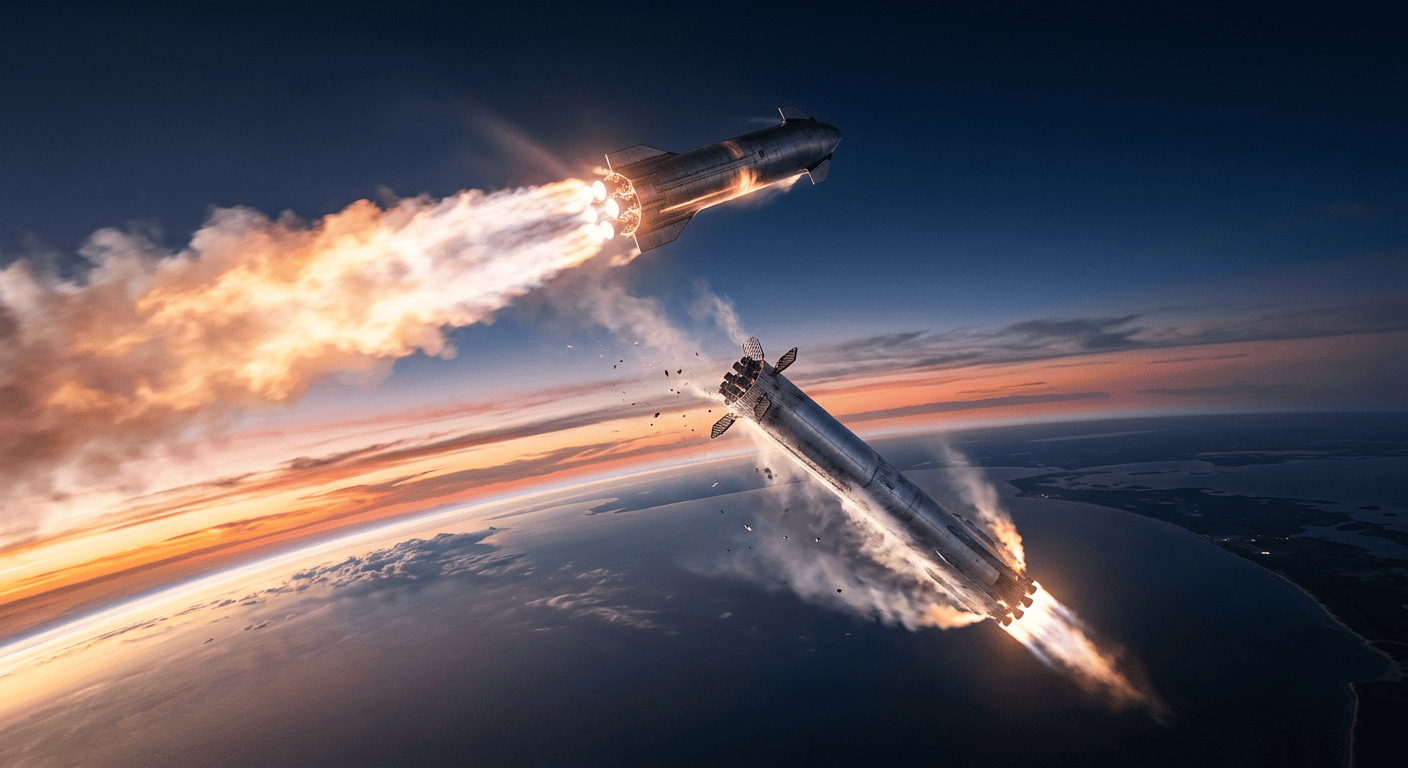
Starship is different. It's built like an airplane. Both stages come back. The booster gets caught mid-air by giant mechanical chopsticks on the launch tower. The ship itself is designed to return and refuel. Nothing gets thrown away.
And because nothing gets thrown away, the only real cost is fuel. Methane fuel costs about $1-2 million per launch. That's how Elon claims they can drop the cost from $100 million per launch to just $10 million. More importantly, that's how the cost per kilogram drops from $2,700 to you guessed it $200.
Business #2: Starlink (The Cash Machine)
Now we're talking. Starlink is the reason this whole thing doesn't collapse tomorrow. With over 8,400 satellites beaming internet down to every corner of the planet, this division operates at a 63% profit margin.
Let that sink in. AWS, Amazon's legendary profit engine that everyone worships, runs at about 50% margins. Starlink is sitting at 63%. A telecom business that didn't even exist five years ago is now, by margin, the most profitable telecom operation on Earth.
This is the fund that pays for everything else. Every dollar Starlink makes helps finance the rocket division's losses and fuels the third piece of this puzzle.
Business #3: XAI (The Wild Card)
This is where things get really interesting. In February, SpaceX swallowed xAI, Elon's AI company. And the valuation math here is... well, let's just say it's aggressive.
OpenAI, with $24 billion in revenue, is valued at $850 billion. That's a 35x multiple. Anthropic, pulling in $30 billion, sits at a $400 billion valuation, or about 13x revenue.
xAI? They've got $3.2 billion in revenue and a $250 billion valuation. That's a 78x multiple. More than double OpenAI's multiple. More than six times Anthropic's.
People are already debating whether OpenAI and Anthropic are overvalued. And here's xAI, trading at multiples that make those companies look conservative.
The $200 Question That Changes Everything
So why would anyone structure a company like this? Why have one division bleeding billions, another burning through cash at an insane rate, and only one actually making money?
The answer lies in a problem that's about to crush the entire tech industry.
Right now, AI data centers are consuming electricity and water at rates that are frankly terrifying. A single large AI data center uses as much power as 100,000 homes. U.S. electricity prices have jumped 40% since 2021, and near major data centers, some bills have skyrocketed by 267%.
Then there's the water problem. Cooling just one megawatt of data center capacity requires 5,000 to 9,000 gallons of water every single day. Communities near data centers are running out of drinking water.
Here's the trap: AI needs to grow tenfold over the next few years. But we don't have enough power. We don't have enough water. And we can't just stop progress.
So what do we do?
Elon (and Jeff Bezos, for what it's worth) has the same answer: put data centers in space.
Now, I know what you're thinking. That sounds like science fiction. But stick with me here.
In orbit, solar panels work 40% better than on Earth. No clouds, no atmosphere blocking the sun. And while space is freezing at -270°C, the vacuum actually makes cooling harder, not easier. Heat can't escape because there are no air or water molecules to carry it away. You need massive radiators.
The International Space Station generates just 70 kW of heat, but its radiator system weighs 7 tons. Scale that up to a 1-megawatt data center, and you're looking at 100 tons of radiators for every 10 tons of computers.
Here's where that $200 number becomes everything.
At today's launch cost of $2,700 per kilogram, putting a data center in space costs $32 million per megawatt. On Earth, it's $12-15 million. Space is more than double the cost.
But drop that launch cost to $200 per kilogram? Suddenly space comes down to $27 million per megawatt. Over the lifetime of the data center, the savings on power and water make orbital data centers cheaper than terrestrial ones.
That's the entire bet. That's why SpaceX is worth $2 trillion despite losing billions. They're not selling rockets. They're selling the only solution to a problem that's about to strangle the entire AI industry.
The Red Flags Nobody's Talking About
Now, I'd be doing you a disservice if I didn't point out the very real risks here. Because make no mistake, this is risky.
Red Flag #1: The Technology Doesn't Exist Yet
SpaceX claims a total addressable market of $28 trillion, roughly the size of the entire U.S. economy. Most of that depends on AI data centers in space. But the technology to make this work? Still in development.
Nobody has ever launched 100-ton radiators at scale. Nobody has proven that Starship can actually achieve $200 per kilogram. That's a target, not a reality. At today's real price of $2,700 per kg, the entire business model is 20 times too expensive to work.
Red Flag #2: The Burn Rate Is Insane
xAI burns roughly $4 for every dollar it earns. The rocket division pours $3 billion a year into Starship development. Starlink's 63% margin is carrying literally everything.
If competitors like Amazon's Project Kuiper or China's satellite constellations enter the market and drive down Starlink's margins, the whole house of cards could tumble. The cash machine that funds this dream isn't invincible.
Red Flag #3: The Retail Investor Puzzle
Here's something that caught my attention. In the SpaceX IPO, 20% of shares went to retail investors. That's three to six times more than a typical IPO.
Think about that. When a company is absolutely certain it's going to multiply in value, institutional investors fight tooth and nail to keep every share for themselves. They don't hand out big slices to regular people.
So why did SpaceX give retail investors such a huge piece of the biggest IPO in history? Either Elon genuinely wants the public to share in the upside, or SpaceX wanted to sell these shares at the highest possible price before reality sets in.
I've seen both scenarios play out in my career. I'm not saying which one this is. I'm just saying you should ask the question.
Red Flag #4: The Valuation Math Is Aggressive
That 78x revenue multiple for xAI? It's dicey. Even if you believe in the space data center vision, paying those kinds of multiples for a company burning cash at that rate requires everything to go perfectly. And in business, everything almost never goes perfectly.
Three Numbers to Watch
So is SpaceX the Amazon of 1997 or the biggest bubble in corporate history? Honestly, it could be either. And you can track which way it's going by watching three specific numbers.
Number 1: Starship's Real Cost Per Kilogram
Every successful reusable Starship flight needs to push that $2,700 toward $200. If it stalls out at $1,000 or $1,500, we have a serious problem. The entire economic model depends on hitting that $200 target.
Number 2: Starlink's Profit Margin
That 63% margin can't drop significantly. If Amazon or China drives prices down and margins compress to 40% or 30%, there's not enough cash to fund the rocket development and AI investments.
Number 3: The Texas Chip Fab
SpaceX, Tesla, and xAI are building a massive chip fabrication plant in Austin with Intel, valued at $119 billion. If chips actually start flowing out of Texas at scale, Elon's vertically integrated dream becomes real. If it becomes another delayed mega-project, it's just another expensive promise.
The Bottom Line
Look, everything Elon Musk does sounds crazy at first. In 2002, he spent his PayPal fortune on the absurd idea that rockets should fly more than once. Everyone laughed for thirteen years. Then a rocket actually landed in the Atlantic, and suddenly it didn't sound so crazy anymore.
Today, that same man is selling the world an even bigger absurdity: that the future of the internet and AI doesn't live on Earth, but in orbit around it.
Physics says it's possible. The finances make absolutely no sense right now. And the stock market says this promise is worth $2 trillion.
The biggest IPO in history isn't really a bet on rockets. It's a bet that electricity, land, and water, the three things every economy is built on, are about to become the scarcest assets on Earth. And that the only way forward is up.
Whether that makes SpaceX the greatest investment opportunity of our generation or the most expensive bubble in corporate history comes down to one number: $200 per kilogram.
What do you think? Are you buying the vision, or does this smell like a bubble to you? Drop your thoughts in the comments. I read every single one.