
- Posted on
- • Technology
Tesla Cybercab Testing Without Steering Wheel Begins on Austin Roads
- Author
-
-

- User
- iamhamzatahir
- Posts by this author
- Posts by this author
-
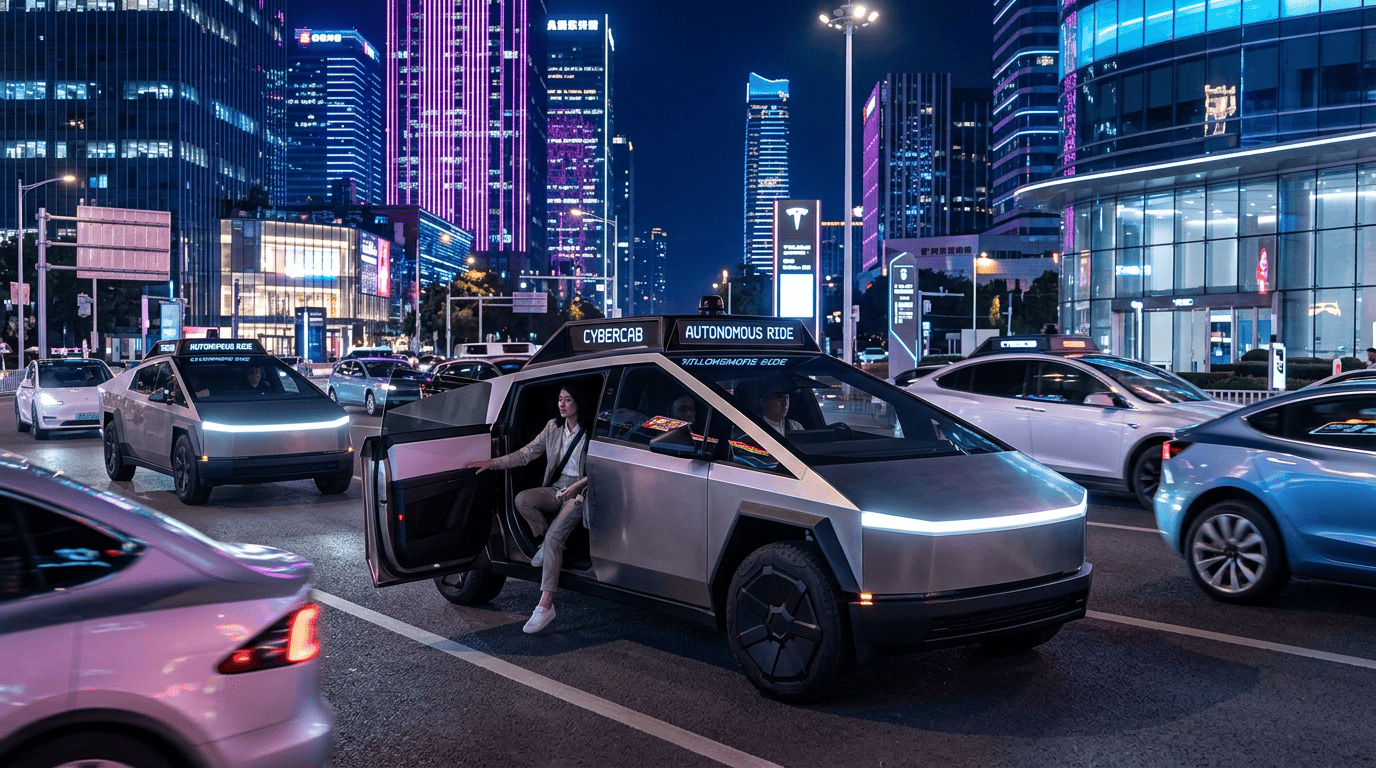
Thirty-four Teslas rolled through downtown Austin today with no steering wheel, no brake pedal, and no human behind anything resembling a driver's seat. That's not a typo, and it's not a concept render. The Tesla Cybercab testing phase that Elon Musk has promised for years is now physically happening on public streets — and the implications land differently when you watch the actual footage.
A safety monitor sits inside each vehicle during this phase, but they've got nothing to grab. No wheel. No pedals. Just a screen, a seatbelt, and whatever nerves they brought with them that morning.
This is the first time a major automaker has put production vehicles without any driver controls onto American public roads. Whether that fact excites you or terrifies you probably says a lot about how much you trust software with your life.
How the Tesla Cybercab Got to Austin Streets
The Cybercab didn't appear overnight. Musk first showed off the concept at the "We, Robot" event in October 2024, where 20 prototypes gave short rides to attendees at Warner Bros. Studios in Burbank. Those early units already lacked a steering wheel — this was always the plan.
Production started at Gigafactory Texas in February 2026. By mid-March, test units were spotted on roads in both Silicon Valley and Austin, with roughly 25 vehicles running cycles near the factory. On April's Q1 earnings call, Musk confirmed production was officially underway, describing the ramp-up as a "stretched out S-curve" — very slow at first, then accelerating toward the end of the year.
Today's 34-vehicle deployment isn't Tesla's first autonomous play in Austin, either. The company launched unsupervised robotaxi rides using Model Y vehicles back in January 2026 and expanded to metro-wide coverage by early June. Public rides opened on June 22. The Cybercab hardware is essentially being layered on top of an autonomous infrastructure Tesla has already been building for months.
That context matters. Tesla isn't cold-starting a robotaxi service. It's upgrading the fleet with a vehicle designed from scratch for this exact purpose.
What Makes the Cybercab Different From Every Other EV
Strip out the steering column and pedal assembly from a car and you don't just save weight — you rethink the entire vehicle. Tesla did exactly that.
The Cybercab is a two-passenger, teardrop-shaped EV that weighs about 3,113 pounds. That's roughly 700 pounds lighter than the lightest Model 3. The body narrows sharply at the rear, optimized purely for aerodynamic efficiency rather than trunk space or rear-seat comfort. It's a vehicle designed for one job: moving two people from point A to point B without any human touching a control.
The efficiency numbers from EPA filings are striking:
- 165 Wh/mi — the most efficient EV ever certified
- ~293 miles of estimated real-world range from a compact 48 kWh battery
- Unadjusted city range exceeding 418 miles
- Energy cost of roughly 2.6 cents per mile at average U.S. electricity prices
- Wireless inductive charging with planned efficiency above 90%
A single 163 kW front motor handles propulsion. Nothing about this powertrain is exotic — the engineering achievement is in how little energy the vehicle wastes. When your car doesn't need to accommodate a driver's seating position, pedal box, or steering rack, you gain real freedom in packaging and aerodynamics.
Tesla is targeting a price under $30,000 per unit, with operating costs between $0.20 and $0.40 per mile at scale. Those numbers would make it cheaper per mile than owning most economy cars.
Tesla Cybercab Testing and the SAE Level 4 Question
Tesla's first responder guide for the Cybercab classifies it as an SAE Level 4 automated driving system. That designation means the vehicle can handle the full driving task without human input within its approved operating conditions.
The operating domain is broader than you might expect. According to Tesla's documentation, the Cybercab is designed for freeways, highways, city streets, rural roads, parking lots, charging stations, car washes, and parking garages. It's supposed to handle daytime, nighttime, light rain, moderate rain, fog, and snow.
When conditions get too extreme — heavy storms, severe ice — the vehicle is designed to stop accepting new ride requests, pull to the nearest safe location, and contact Tesla's robotaxi support team.
The emergency handling features are worth noting specifically. The Cybercab's cameras and microphone array can detect sirens and emergency vehicles approaching from behind. It'll automatically pull over and yield. If a collision occurs, the system deactivates autonomous mode, unlocks all doors, lowers windows if airbags deployed, and initiates a two-way call with support staff.
On paper, that's thorough. The question is whether the software behind those protocols performs reliably in the chaos of real-world driving.
The Safety Gap Nobody Should Ignore
Here's where the story gets uncomfortable.
Tesla's supervised robotaxi fleet — running on the same underlying FSD software the Cybercab will use — currently records one crash per 57,000 miles. The human driving benchmark sits around one crash per 229,000 miles. That's a crash rate roughly four times higher than the average human driver.
I've watched enough product launches to know that "the software will improve" is the most common promise in tech. Sometimes it's true. But when the product is a three-thousand-pound machine sharing lanes with school buses and cyclists, "it'll get better" isn't a comfort — it's a gamble.
A Reuters investigation added another layer of concern. The outlet found that Tesla's published safety comparisons contained a methodology problem: Tesla counted only crashes where airbags deployed in its own vehicles, then compared that figure against federal data capturing all crashes severe enough to require a tow truck. Tow-truck crashes frequently don't involve airbag deployments. That mismatch inflated Tesla's claimed safety advantage by a factor of roughly three.
Seven of nine former Tesla data labelers interviewed by Reuters said they personally wouldn't trust FSD to drive them. They described the system failing at tasks most human drivers handle instinctively — yielding for emergency vehicles, giving motorcyclists adequate clearance, braking appropriately on freeway off-ramps, and avoiding construction zones.
Musk himself acknowledged on the Q1 earnings call that the software still has issues. He described situations where vehicles get "scared to move" or become trapped in infinite loops. He also estimated Tesla needs around 10 billion miles of driving data to reach safe unsupervised operation and projected the company would cross that threshold around July 2026. But collecting data is step one. Training, validation, and debugging millions of edge cases come after.
Regulations Are Moving — But Not Fast Enough for Everyone
The federal regulatory picture is shifting in Tesla's favor, though nothing is finalized.
NHTSA has proposed amendments to federal safety standards that would exempt fully driverless vehicles from manual control requirements. The Trump administration backed these changes, proposing updates that would eliminate the mandate for brake pedals in cars designed for full autonomy. A 30-day public comment period is now open.
Tesla sidestepped one of the biggest regulatory bottlenecks entirely. NHTSA caps autonomous vehicle production at 2,500 units per year for companies using safety standard exemptions — a limit that has constrained competitors like Waymo and Cruise. Tesla's VP of Vehicle Engineering, Lars Moravy, confirmed the Cybercab was designed to comply with all existing Federal Motor Vehicle Safety Standards without needing a waiver. No exemption means no cap.
That's a significant strategic advantage. While competitors petition for permission to build more vehicles, Tesla can scale production without a federal ceiling.
At the state level, Texas green-lit testing after a law took effect on May 28 allowing self-certified Level 4 vehicles to operate without a driver. Most other states remain cautious. California and New York have implemented their own strict requirements, and the lack of a unified federal framework means automakers face a contradictory patchwork of rules depending on geography.
Tesla's next target? Washington, D.C. Operating robotaxis in the shadow of federal regulators and lawmakers would be a deliberate statement — part technology demonstration, part lobbying tactic.
The Paradox Sitting on the Assembly Line
Imagine you're a Tesla investor watching today's footage. The Cybercab looks incredible — sleek, efficient, purpose-built. Then you remember the crash rate data. You remember Musk's autonomous driving promises stretching back to 2016. You remember that three senior leaders on the Cybercab program have departed since February, including the vehicle program manager who left days after the first unit rolled off the line.
The situation creates a genuine tension. Tesla is mass-producing a vehicle designed to have no driver while the driving software still isn't reliably safe without one. Every Cybercab that ships before the software is ready is an expensive piece of hardware waiting for a brain that keeps being promised but hasn't fully arrived.
Production targets aim for hundreds of units per week in the near term, with long-term ambitions reaching millions annually. The business model — subscription-based urban transport replacing personal car ownership — only works if the autonomy works. Operating costs of pennies per mile mean nothing if the vehicle can't actually operate unsupervised.
Cybercabs are expected to join Austin's robotaxi fleet as early as July, though August is a more realistic estimate. Musk suggested unsupervised FSD would reach customer vehicles by Q4 2026. Given Tesla's historical accuracy on FSD timelines, healthy skepticism feels appropriate.
Still, today's test run is real. Hardware without a steering wheel is driving on public roads, processing real traffic, and collecting the data Tesla says it needs. The gap between ambition and execution is measurable now — not theoretical.
Whether that gap closes fast enough to justify the hype, or whether it becomes the most expensive lesson in automotive history, probably depends on the next six months more than the last ten years. What's your read — is Tesla ahead of the curve, or ahead of its own software?