
- Posted on
- • Technology
Space Data Centers: The Wild Solution to Our Power Crisis
- Author
-
-

- User
- iamhamzatahir
- Posts by this author
- Posts by this author
-
Somewhere in northern Virginia, a warehouse-sized building with no windows hums loud enough to register on seismic monitors. Inside, thousands of servers chew through enough electricity to power 100,000 homes. Outside, the local water utility just imposed usage restrictions on commercial customers for the third summer in a row. The data center didn't make the news. It rarely does.
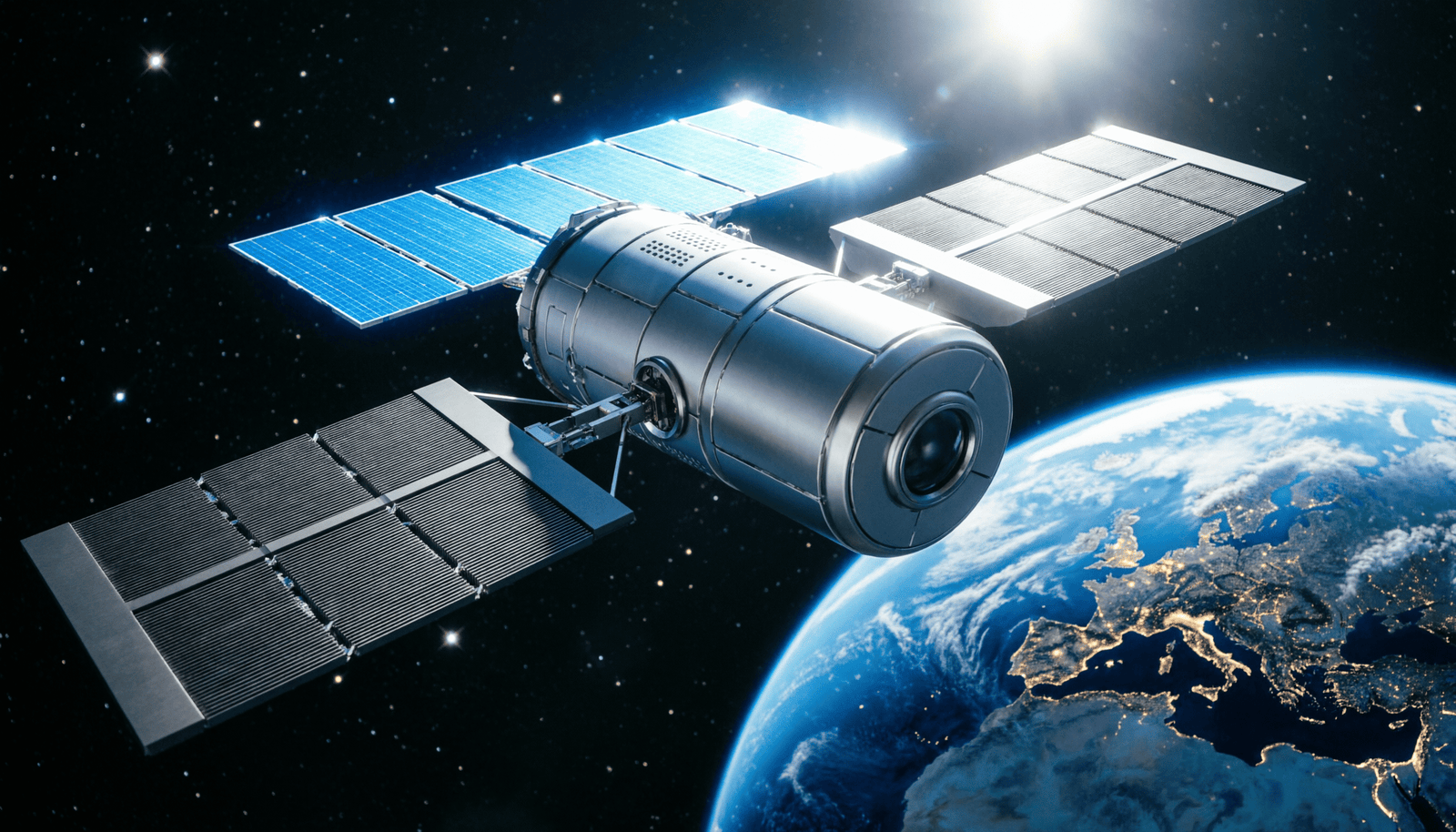
You probably picture the cloud as an invisible, weightless thing. It is not. It is a sprawling network of physical buildings eating electricity and drinking water by the gallon. And we have hit a physical wall. The digital expansion we rely on is actively choking the planet. That is exactly why tech billionaires are looking up. They want to build data centers in orbit. It sounds like science fiction. But when you look at the raw math behind our current infrastructure, putting servers in space suddenly stops looking crazy and starts looking necessary.
Electricity prices in the US have climbed 40% since 2021, and communities near major facilities have watched their bills spike by as much as 267%. Meanwhile, cooling those servers requires thousands of gallons of water every day. So when Elon Musk and Jeff Bezos both land on the same radical idea — moving data centers into orbit — it stops sounding like science fiction and starts sounding like desperation with a business case.
The Data Explosion Nobody Planned For
Here is a number that should stop you cold. Until 2010, all of human civilization had produced roughly two zettabytes of data. Everything — every email, every photo, every government record, every medical file, every spreadsheet. Two zettabytes, total.
But launch costs are not static. Starship changes the equation. If SpaceX achieves its target pricing of $200 per kilogram to orbit — and they are actively testing toward that goal — the space deployment cost drops to roughly $27 million. That is still a premium over terrestrial construction, but suddenly within shouting distance.
And that is only half the equation. You have to look at the lifetime operational costs. On Earth, you buy expensive real estate. You build a concrete fortress. You run miles of fiber optic cable and construct massive electrical substations. You face perpetual, rising water and electricity bills. An orbital setup generates its own boundless solar power and requires zero water for cooling. No ongoing electricity bill from the grid. No water procurement or treatment costs. No real estate battles in increasingly hostile permitting environments.
Over a 10- to 20-year facility lifespan, those operational savings close the gap — and potentially flip the math entirely. In regions where power and water are scarcest, the orbital option might actually come out cheaper.
Now imagine you are running infrastructure planning at a major cloud provider. You have got a three-year wait for grid connection in Northern Virginia, water restrictions tightening in the Southwest, and AI customers demanding capacity now. A space-based option that costs 80% more upfront but delivers in 18 months with zero resource constraints? That pitch starts landing differently in the boardroom.
Escaping the Regulatory Gridlock
There is another massive advantage to moving servers off-world. It has nothing to do with physics and everything to do with paperwork.
Building a new terrestrial facility today is a regulatory nightmare. You need zoning approvals. You need environmental impact studies. You need to negotiate water rights with local municipalities. You need to beg the regional grid operator for more power capacity. These processes take years. Sometimes they fail entirely. Local communities are actively fighting back against data center construction.
Space has no zoning board. There is no local municipality to complain about the noise or the water usage. While orbital debris management and spectrum allocation are real concerns, they are handled at an international level. The friction of getting a project approved in orbit is fundamentally different from fighting a multi-year legal battle in a rural county.
Think about the time value of money. A terrestrial project stuck in permitting hell for three years loses millions in potential revenue. An orbital project launched next month starts generating value immediately. The speed of deployment in space could completely bypass the bureaucratic gridlock strangling terrestrial expansion. For tech companies operating on tight deployment timelines, the regulatory vacuum of space is incredibly appealing.
The Problems Nobody Has Solved Yet
Significant hurdles remain, and it would be a disservice to pretend otherwise:
- Latency. Light takes time to travel. Data bouncing between orbit and Earth adds milliseconds of delay. For real-time applications — financial trading, gaming, video calls — that matters. For batch AI training and large-scale computation? Less so. The likely model is a split architecture: latency-sensitive workloads stay on Earth near population centers, while heavy compute — the model training runs that can tolerate a few hundred milliseconds of round-trip delay — moves off-planet.
- Maintenance. When a server fails on Earth, a technician swaps the drive. In orbit, you are looking at robotic repair systems or disposable satellite modules. Neither is cheap or proven at scale.
- Space debris. Every new object in orbit increases collision risk. A cloud of data center satellites adds complexity to an already crowded orbital environment.
- Data sovereignty. Governments regulate where citizen data can be stored. A server in low Earth orbit crosses multiple national boundaries every 90 minutes. The legal frameworks are not ready for that. Neither are most corporate compliance departments.
- Radiator mass. Solving the thermal management problem — finding ways to dissipate megawatts of heat without adding megatons of launch weight — will require materials and designs that do not exist yet at scale.
These are not small problems. But none of them are physics violations, either. They are engineering and policy challenges — the kind that money and motivation tend to solve.
What Space Data Centers Really Tell Us
The most revealing thing about this idea is not whether it works. It is that serious people — backed by billions of dollars — believe Earth-based infrastructure is approaching a hard ceiling. That is the signal worth paying attention to.
We have spent decades assuming that data infrastructure just scales. Build another building, run more fiber, add more cooling towers. But AI broke that assumption. The energy and water demands of modern computing are growing faster than our ability to supply them on the ground, in the places where people actually live.
What is quietly encouraging is that the three hardest problems — launch cost, power generation, and thermal management — are all trending in the right direction. Launch costs are falling faster than most projections anticipated. Solar panel efficiency keeps improving. And the same material science advances that benefit electric vehicles and grid storage apply directly to lighter, more efficient radiators.
Space data centers might be part of the answer. So might nuclear microreactors, liquid immersion cooling, and entirely new chip architectures that generate less heat. The real solution to infrastructure problems this big is never a single technology — it is a portfolio of bets, running in parallel, with the market eventually sorting out which ones scale.
What strikes me most is the timeline. This is not a 2050 conversation anymore. Starship is testing now. AI demand is compounding now. Water tables are dropping now. The gap between "wild idea" and "funded project" has never been shorter in aerospace. If the cost per kilogram to orbit drops even halfway to SpaceX's target, the first commercial space data center module could launch before the decade is out.
We tend to treat digital growth as an abstract concept. We assume the internet will just scale itself. It will not. The physical limits of our planet are dictating the future of the digital economy. The AI energy consumption rate is scaling faster than our ability to build new power plants. Moving our most power-hungry servers into orbit is not just a vanity project for billionaires. It is a logical response to a thermodynamic crisis.
We are running out of room on the ground. The next decade of computing might not be built on land at all. The real question is not whether we can build these space data centers. The question is whether we will build them before our terrestrial grid completely collapses under the weight of our own data — and whether you find that thrilling or terrifying probably says something about how you feel about the trajectory of AI itself, and whether you think we can keep feeding it from down here.