
- Posted on
- • Space Tourism
Is Space Tourism Bad for the Environment? Emissions, Ozone, and What's Next
- Author
-
-

- User
- iamhamzatahir
- Posts by this author
- Posts by this author
-
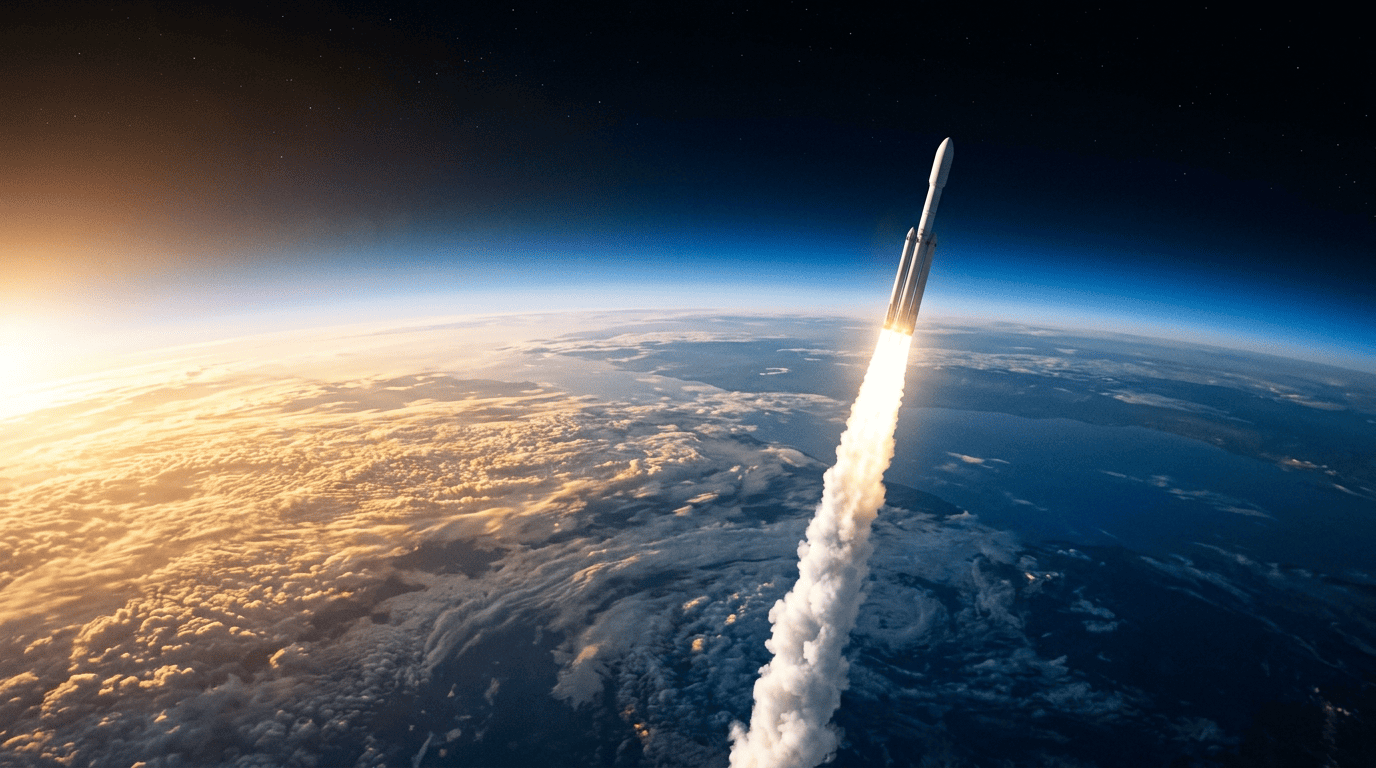
Imagine spending 90 minutes above the clouds and walking away with a carbon footprint equivalent to 278 people on a transatlantic flight. That's not a hypothetical. Space tourism's environmental impact is real, measurable, and — depending on how fast this industry scales — potentially significant. And yet the conversation rarely goes deeper than a vague "rockets bad" or a dismissive "it's too small to matter."
The truth is more complicated. Right now, the numbers are still relatively small. But the trajectory? That's where things get interesting — and a little unsettling.
Why Rocket Emissions Hit Differently Than Plane Emissions
On the surface, rockets don't look like the world's biggest polluters. At present, space flight is equivalent to at most 2% of the emissions of the aviation sector. That sounds manageable. But that single statistic misses the whole point — it's not just how much is emitted, it's where and what.
When a commercial jet cruises at 35,000 feet, its exhaust disperses in the troposphere, where weather systems help break things down over time. Rockets punch through that layer entirely and release pollutants directly into the stratosphere — the thin, UV-shielding band of atmosphere that starts around 12 kilometers up and extends to about 50 kilometers. Stuff deposited up there doesn't just drift away. It lingers.
The headline pollutant isn't CO₂. It's black carbon — or soot. Soot particles from rockets are far more damaging than ground-based emissions. Researchers explain that these particles are 500 times more effective at warming the atmosphere, particularly because they are released at high altitudes where they absorb solar radiation without interference.
That altitude effect is the crux of the problem. Ground-level soot is bad. Stratospheric soot is an entirely different category of bad.
The Numbers Behind Space Tourism's Carbon Footprint
Here's where the data gets genuinely striking. A space tourism flight, which lasts on average about an hour and a half, generates as much pollution as a 10-hour transatlantic flight and carries the same carbon footprint as 278 people combined.
Per passenger, it's even more jarring. CO₂ emissions for the four or so tourists on a space flight will be between 50 and 100 times more than the one to three tonnes per passenger on a long-haul flight.
A research model published in PLOS One pushed that comparison even further. Suborbital tourism releases 400 to 1,000 times more CO₂ per passenger per hour compared with commercial aviation flights. That's not a rounding error — that's a structural difference in how much energy it takes to escape Earth's gravity versus fly across an ocean.
For context on what this could look like at scale: if the demand for suborbital flights increases significantly, total annual emissions could reach as large as 21 million tonnes of CO₂ per year within a decade, which exceeds the annual emissions of more than 100 countries. Nobody's saying that's inevitable. But it's the direction things are heading if the industry grows without constraints.
And it's not just CO₂. During launch, rockets can emit between 4 and 10 times more nitrogen oxides than the largest thermal power plant in the UK, over the same time period. Nitrogen oxides at altitude are a known ozone depleter — which brings us to the research that's caused the most alarm.
What the MIT, Cambridge, and UCL Research Actually Found
In 2022, a team of researchers from UCL, the University of Cambridge, and MIT published a study that's since become the most widely cited work on this topic. They weren't just looking at CO₂. They modeled the full atmospheric chemistry of routine space tourism launches — and what they found about the ozone layer was sobering.
Due to the recent surge in re-entering debris and reusable components, nitrogen oxides from re-entry heating and chlorine from solid fuels contribute equally to all stratospheric ozone depletion by contemporary rockets. The decline in global stratospheric ozone is small at 0.01%, but reaches 0.15% in the upper stratosphere in spring at northern latitudes after a decade of sustained growth in launches and re-entries.
That baseline figure gets worse when space tourism is factored in separately. With a decade of emissions from space tourism rockets specifically, ozone depletion could reach 0.24%, undermining the ozone recovery achieved through the Montreal Protocol. The Montreal Protocol is arguably the most successful international environmental agreement in history — signed in 1987 to phase out chlorofluorocarbons, it's been credited with saving the ozone layer. The idea that space tourism could quietly chip away at those gains is not a fringe concern.
The black carbon findings were equally striking. Rocket emissions of black carbon produce substantial global mean radiative forcing of 8 milliwatts per square meter after just three years of routine space tourism launches. After just three years of more than once-a-day rocket launches, space tourism would account for 6% of warming due to black carbon emissions despite contributing just 0.02% of global black carbon emissions. The disproportionality there — 0.02% of emissions driving 6% of warming — is the stratospheric altitude effect in action.
The researchers were clear that international regulation is needed. These findings support the need to develop international regulation to mitigate environmental harm caused by launch and re-entry emissions of a fast-growing industry.
What Each Company Is Actually Doing About It
Not every rocket is the same. Fuel type makes a significant difference, and the major players in space tourism have made very different bets.
SpaceX — The Reusability Argument
SpaceX's central environmental claim isn't cleaner fuel — it's reusability. The logic is straightforward: if you can fly the same rocket booster dozens of times instead of discarding it after one use, you dramatically reduce the manufacturing footprint per flight. SpaceX's Falcon 9 rockets lift off every few days, with self-landing boosters touching back down after every launch. That operational cadence is genuinely impressive.
The fuel, however, is still kerosene-based on the Falcon 9 — a dirtier option compared to alternatives. SpaceX's next-generation Starship uses liquid methane and liquid oxygen, which burns cleaner. If methane is used as fuel, its emissions may become comparable to those using liquid hydrogen, though its maximum reduction in emissions can only be less than 10% because that is the amount associated with fuel production. Reusability helps. But it doesn't solve the problem on its own.
Blue Origin — The Hydrogen Bet
Blue Origin's New Shepard vehicle uses liquid hydrogen and liquid oxygen — a combination that produces water vapor rather than CO₂ during combustion. On paper, that sounds like the cleanest option available. However, spacecraft using liquid hydrogen still carry 90 to 106 metric tonnes of indirect CO₂ emissions due to the fuel production process. Hydrogen, in most current production methods, is made using natural gas — so the carbon gets emitted upstream, not at the launchpad.
Blue Origin is also now committed to reusability. Blue Origin successfully reused one of its New Glenn rockets for the first time, marking a major milestone for the heavy-launch system. The combination of hydrogen propellant and reusable hardware is probably the most environmentally considered approach among traditional rocket operators — though "most considered" is doing a lot of heavy lifting in that sentence.
Space Perspective — The Outlier
Then there's Space Perspective, which isn't a rocket company at all. Rather than a bone-rattling rocket launch, their balloon rides to the stratosphere are "very gentle" — there are no high-G forces, training isn't required, and trips don't release carbon emissions. Their pressurized capsule uses a hydrogen-filled balloon to float passengers to the upper atmosphere over a six-hour journey.
The catch: you don't get the weightlessness, the orbital speed, or the dramatic view from true space. It's a different product entirely. But as a proof of concept for low-impact near-space tourism, it's genuinely interesting — and worth watching.
Is Space Tourism Getting Better or Worse Environmentally?
Honestly? Both, depending on which metric you're watching.
The technology is improving. Reusable rockets are becoming the norm rather than the exception. By 2024, global rocket launches had soared to 2,849 launches worldwide — a nearly fivefold increase from 2019. More launches with reusable hardware means lower per-launch manufacturing impact, but the sheer volume growth is still pushing total emissions upward.
The regulatory framework hasn't kept pace. International regulations on rocket emissions are currently limited. Unlike aviation, which is governed by bodies like the International Civil Aviation Organization, space travel lacks comprehensive oversight. There's no equivalent of the Paris Agreement specifically addressing rocket soot in the stratosphere. Nobody's setting emission caps, reporting standards, or mandatory fuel efficiency benchmarks for the space tourism sector.
That regulatory gap is arguably the biggest environmental risk — not the emissions themselves in their current form, but what unregulated rapid scaling could look like by 2035.
The Harder Question Nobody Wants to Answer
There's a version of this debate that goes beyond the chemistry. Some argue that space tourism fosters a "planetary perspective," inspiring environmental responsibility. Astronauts often experience the "Overview Effect" — a cognitive shift from seeing Earth from space that fosters a sense of interconnectedness and stewardship.
It's a compelling idea. Several astronauts have described coming back from orbit as genuinely changed — more committed to protecting the planet, more viscerally aware of how fragile the atmosphere looks from above. But critics question whether this perspective justifies the environmental costs, especially when only the wealthy few can participate.
That's the tension at the heart of this. Space tourism, in its current form, is a product for billionaires and millionaires. Virgin's emissions work out to around 4.5 tonnes per passenger in a six-passenger flight — roughly equivalent to driving a typical car around the Earth, and more than twice the individual annual carbon budget recommended to meet the Paris climate accord objectives. The people generating those outsized emissions are almost certainly already high-carbon consumers in every other dimension of their lives.
None of this means space tourism is irredeemably wrong. But it does mean the industry needs to be held to a higher standard than it currently is — not because rockets are uniquely evil, but because the stratosphere is uniquely vulnerable, and because the industry is at a moment where its norms are still being set.
The choices made in the next five years — on fuel types, reusability standards, launch frequency, and regulatory frameworks — will define the environmental legacy of this entire era of commercial spaceflight. What kind of precedent do we want to set for an industry that's only going to get bigger? That question is worth asking before the answer gets made for us.