
- Posted on
- • Space Tourism
Suborbital vs Orbital Space Tourism: Cost, Experience, and Which Is Right for You
- Author
-
-

- User
- iamhamzatahir
- Posts by this author
- Posts by this author
-
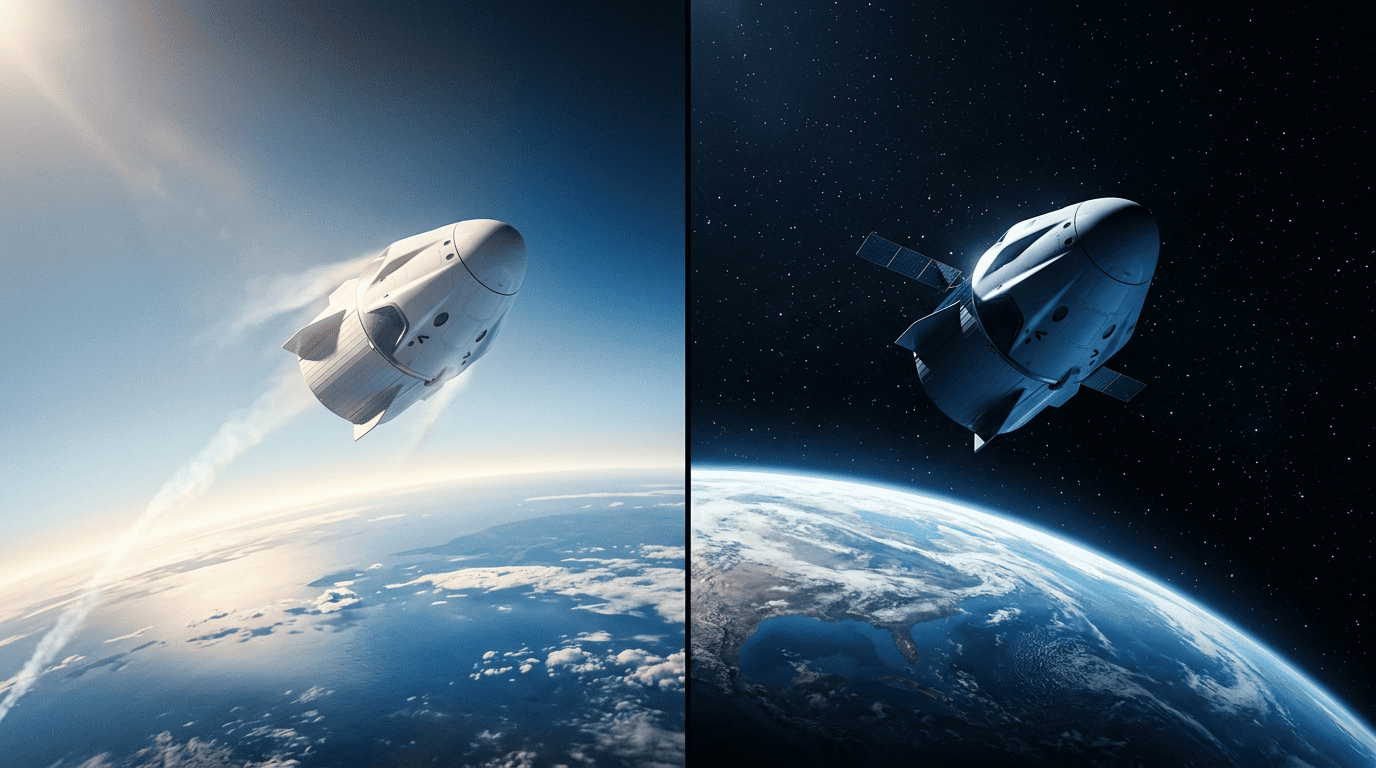
Someone once paid several hundred thousand dollars for a Virgin Galactic ticket and asked the tour operator what planets they'd be visiting. That actually happened. And honestly? It's not as ridiculous as it sounds — because the difference between suborbital and orbital space tourism is something even well-read, curious people routinely get wrong.
So let's fix that. If you've ever wondered what separates a ten-minute rocket hop from a multi-day mission circling Earth — and which one makes more sense for you — this is the comparison you've been looking for.
The Core Difference Between Suborbital and Orbital Space Tourism
The simplest way to think about it: suborbital flights go up and back down. Orbital flights go up and keep going — fast enough that they circle the Earth rather than fall back immediately.
Suborbital flights take passengers to altitudes of about 80–100 km and return to Earth without circling the planet, providing a few minutes of weightlessness and a view of Earth from space. The rocket or spaceplane punches through the atmosphere, crests the boundary of space in a graceful parabolic arc, and comes back down. The whole thing — takeoff to touchdown — typically lasts around 90 minutes. Your actual time floating in weightlessness? A matter of minutes.
Orbital flight is a completely different beast. Orbital flights travel fast enough to remain in orbit around Earth, reaching speeds of about 28,000 km/h. At that velocity, the spacecraft is essentially falling around the curve of the planet continuously. You don't just visit space — you live in it, for days or weeks at a time.
There's also the question of where space actually begins. NASA and the U.S. Air Force generally define the edge of space as 80 km above sea level, while the internationally recognized Kármán line — widely accepted as the boundary of outer space — lies at 100 km. This affects how different companies describe their flights. Virgin Galactic targets roughly 86 km — technically space by the U.S. definition, but below the Kármán line used internationally. Blue Origin crosses the 100 km mark. Neither gets anywhere near orbit.
Suborbital vs Orbital: Side-by-Side Comparison
| Factor | Suborbital | Orbital |
|---|---|---|
| Altitude | 80–107 km | 400–1,400 km |
| Speed | ~3,500 km/h | ~28,000 km/h |
| Duration in space | 3–5 minutes weightlessness; ~10–90 min total | Days to weeks |
| Ticket cost | ~$250K–$750K | $50M–$70M |
| Training required | A few days | Several months |
| G-forces | 3–4 g at peak | 3–6 g (launch + reentry) |
| Key providers | Blue Origin, Virgin Galactic | SpaceX / Axiom Space |
The Suborbital Experience: Space in a Sprint
Think of a suborbital flight as the most extreme roller coaster ever built — except instead of a loop at 100 km/h, you're cresting the edge of space before the Earth pulls you back.
Blue Origin developed the New Shepard reusable suborbital launch system specifically to enable short-duration space tourism, planning to ferry a maximum of six persons on a brief journey to space. The New Shepard capsule was designed with the passenger experience in mind, boasting the largest windows ever integrated into a spacecraft for panoramic views. After a few minutes of weightlessness, the capsule detaches from the rocket, which lands autonomously for reuse, and descends gently under parachutes. The entire mission lasts about 11 minutes from start to finish.
Virgin Galactic takes a different approach entirely. Founded by Sir Richard Branson, their spacecraft doesn't launch vertically from a pad. Instead, it's carried to high altitude by a massive carrier aircraft; once released, it ignites its rocket motor for the final surge into space. This horizontal launch system feels more akin to high-altitude aviation than a traditional rocket blast-off. They charge $450,000 per seat for a 90-minute trip, including about four minutes of weightlessness.
Training for suborbital flights is refreshingly manageable. For suborbital hops with Virgin Galactic or Blue Origin, preparation takes only a few days and covers safety protocols, microgravity orientation, and G-force preparation via centrifuge simulations. You don't need to be in peak athletic shape. A reasonable baseline of fitness and the ability to handle pressure spikes is generally enough.
Weightlessness lasts only a few minutes on suborbital flights — but passengers who've made the trip consistently describe it as life-altering. Many report the so-called overview effect — a profound shift in perspective when seeing Earth from space. Four minutes of floating above the planet, watching the curvature of the Earth against a black sky, leaves a mark.
The Orbital Experience: Space as a Way of Life (Briefly)
Orbital tourism isn't a thrilling detour. It's an expedition.
SpaceX's Crew Dragon missions offer full orbital experiences. Axiom Space, working with SpaceX, has charged about $55 million per seat for private missions to the International Space Station. This is a completely different level of space tourism — instead of a few minutes in microgravity, passengers spend days in orbit, experiencing what professional astronauts do.
Axiom Space has flown four missions (Ax-1 through Ax-4) between April 2022 and July 2025, carrying a total of 14 crew members for stays of 8–21 days. That's not a brief brush with space. That's sleeping, eating, working, and watching 16 sunrises a day — all in zero gravity.
The training commitment reflects the scale of the challenge. For SpaceX orbital missions, training spans several months and includes complex systems management, emergency survival training for potential water landings, and — if scheduled — preparation for civilian spacewalks. SpaceX's requirements reflect just how complicated orbital flight really is. Passengers train for months, and medical standards are on par with NASA astronauts.
Unlike suborbital flights, which only provide a few minutes of weightlessness before returning to Earth, orbital missions involve staying in space for extended periods — often days or even weeks. The spacecraft must be equipped with life-support systems, shielding against radiation, and high-tech communication infrastructure.
Then there's the milestone factor. In September 2021, the Inspiration4 mission spent almost three days in orbit aboard the Crew Dragon Resilience, becoming the first all-civilian crew to fly an orbital space mission. Three years later, the Polaris Dawn mission in September 2024 reached 1,400 km altitude — the highest human altitude since Apollo — and conducted the first commercial EVA using a SpaceX EVA suit. Orbital tourism isn't just expensive. It's genuinely historic.
The Real Cost Gap — and Why It's So Enormous
There is no single price for space tourism. Space tourism currently ranges from about $750,000 for a short suborbital flight to roughly $55–70 million for an orbital trip to the ISS. That's roughly a 100-fold difference. Why?
Reaching orbit requires roughly tens of times more energy than a suborbital flight, which is the main reason for the large cost gap. It's not just distance — it's speed. Getting to 100 km straight up is one thing. Accelerating to 28,000 km/h so you don't immediately fall back down is another order of magnitude entirely in fuel, engineering, and risk management.
Suborbital flights demand minimal pre-flight training, while orbital missions require extended astronaut training, physical screening, and preparation. Orbital capsules, life-support systems, safety redundancies, and infrastructure all cost significantly more.
The good news: costs are moving. SpaceX's Starship is expected to significantly lower the cost of orbital space travel. Instead of paying $50–60 million, tourists might be able to fly for $10 million by 2030. Suborbital tickets are also trending downward — experts believe suborbital pricing could drop below $200,000 by 2030.
Which One Is Right for You?
Here's the honest framework — budget aside for a moment — because the decision is about more than money.
Choose suborbital if:
- You want the authentic experience of crossing into space and feeling true weightlessness
- You have limited time available for training — days, not months
- You're drawn to the thrill of the moment rather than extended immersion
- Your budget is in the six-figure range rather than eight-figure territory
- You're a thrill-seeker or first-time dreamer who values simplicity and moment-focused excitement
Choose orbital if:
- You want the full astronaut experience — multiple days, genuine scientific engagement, life in microgravity
- You can commit months to pre-flight preparation and meet stringent health requirements
- The overview effect isn't a brief glimpse you're after, but a sustained, life-reframing immersion
- You're a space enthusiast or researcher who wants true experience, scientific possibilities, or a long-term stay
- Budget, while enormous, is not the deciding factor
There's also a practical timing consideration. In January 2026, Blue Origin announced a pause of at least two years to redirect resources toward its Artemis lunar lander programme. Virgin Galactic also paused operations after six commercial flights in 2023–2024 to develop its next-generation Delta-class spaceplane, targeting a return to commercial flights in late 2026. So the suborbital market, for the moment, is in a holding pattern. SpaceX and Axiom remain the primary active providers of human spaceflight for paying customers right now.
What's clear is that both categories are real, both are proven, and both have permanently changed what "travel" can mean. The industry was valued at approximately $608 million in 2023 and is projected to grow to $5.1 billion by 2030. The question of which type of space tourism suits you will only get more pressing — and more answerable — as prices fall and seats open up.
So: if you had the budget today — ten minutes at the edge of the world, or ten days circling it — which would you choose?