
- Posted on
- • Space Tourism
Space Hotels in 2026: Which Projects Are Real and When Can You Book?
- Author
-
-

- User
- iamhamzatahir
- Posts by this author
- Posts by this author
-
Somewhere above your head right now, roughly 250 miles up, the International Space Station is completing another orbit every 90 minutes. Astronauts are up there doing science, maintaining equipment, and staring down at a planet that looks impossibly beautiful from that distance. And for decades, the question has been the same: when does the rest of us get to stay?
Space hotel timelines have been announced, pushed back, rebranded, and announced again. If you've tried to find a straight answer about when a space hotel will actually open — one that's current, honest, and doesn't read like a press release from 2022 — you've probably come up empty. This is that answer.
Here's where every major project actually stands in 2026, which ones are still breathing, and what a realistic timeline looks like for your first night off-planet.
The Space Hotel Landscape in 2026: Active vs. Defunct
Not every project that made headlines is still alive. That matters, because a lot of the "space hotel" content still circulating online references plans that have quietly died.
The clearest example is Aurora Station. Announced as a luxury space hotel set to launch in 2021, the company behind it — Orion Span — announced that it was ceasing operations. Tourists were going to pay $9.5 million for a 12-day stay aboard a station roughly the size of a large private jet's cabin, housing six people: four guests and two crew members. The idea was compelling. The execution never materialized.
Then there's Bigelow Aerospace, which spent years developing inflatable habitat technology and had even launched unmanned test modules. The company suspended operations in 2020 and never resumed. Another promising concept, grounded.
What's left are a handful of genuinely active projects — each at a very different stage of development, and each with a very different definition of what "space hotel" means.
Voyager Station: The Most Ambitious Space Hotel When It Opens
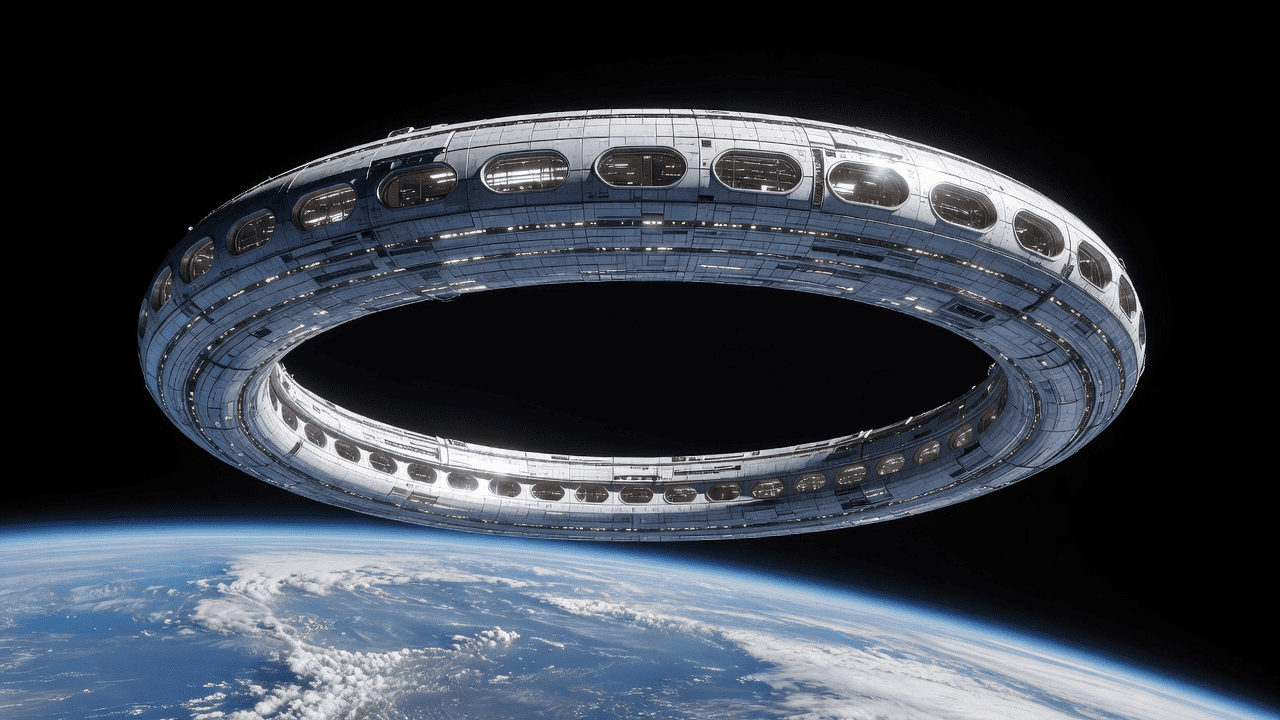
Voyager Station is the one that gets people excited — and for good reason. Developed by U.S.-based Orbital Assembly Corporation, it aims to build a commercial space station in low Earth orbit shaped like a rotating wheel — a structure that will generate artificial gravity through centrifugal force. Think less "floating around in zero-G" and more "luxury resort with a view that no resort on Earth can touch."
The complex is planned to feature rooms and suites with direct views of Earth, as well as common areas typical of a luxury hotel: restaurants, bars, a gym, a spa, and spaces dedicated to scientific and educational activities. A central ring structure will support 24 habitation modules, used for hotel accommodation, restaurants, bars, gyms, crew accommodation, and scientific research pods.
The artificial gravity piece is worth understanding. The station rotates, pushing the contents of the station out to the perimeter, much in the way that you can spin a bucket of water — the water pushes out into the bucket and stays in place. The rotating ring-shaped form will give the station gravity equivalent to one-sixth of Earth's — similar to what you'd feel on the Moon. Enough to keep your coffee in the cup and your feet roughly on the floor.
Now for the honest part. The company — now renamed Above: Space Development Corporation — has announced several widely publicized plans, but as of 2024, no funding for the projects has been announced and construction of the stations has not started. Although the original announcement pointed to a 2027 launch, the company has acknowledged it is a project still in the design and infrastructure testing phase, with ground prototype progress reported during 2025.
Cost estimates are similarly vague. Some estimates put a trip at approximately $5 million, requiring passengers to undergo safety and physical training before boarding the shuttle for a 3.5-day trip to the station. The long-term vision is more democratic — the masterminds behind Voyager Station say they plan to eventually make a stay at the hotel something similar to buying a cruise ticket. How far away that is from reality is anyone's guess.
Verdict: still active, still aspirational, still underfunded. Don't hold your breath for 2027, but don't write it off entirely either.
Axiom Space: The Most Credible Path to a Space Hotel Right Now
Axiom Space doesn't market itself as a hotel. But it may be the project most likely to put a paying civilian in orbit within the next few years — and that distinction matters.
Axiom Space is the only operator under an active NASA contract to attach a commercial module directly to the International Space Station. That's not a press release claim — it's a structural advantage over every other commercial station developer.
In coordination with NASA, Axiom Space modified its planned assembly sequence to accelerate its ability to operate as a viable free-flying space station, with NASA awarding the firm a fixed-price contract in January 2020. Under the new assembly sequence, the Payload, Power, and Thermal Module will launch to the orbiting laboratory first, allowing it to depart as early as 2028 and become a free-flying destination known as Axiom Station, with Habitat 1, an airlock, Habitat 2, and a Research and Manufacturing Facility to follow.
Construction of the world's first commercial space station is underway, with partners at Thales Alenia Space having begun welding and machining activities for the primary structures of Axiom Station's first module, and the first pieces of fabricated flight hardware coming together.
Axiom has also already proven it can get civilians to orbit. Axiom has flown four missions to the ISS, with Axiom-4 launching in June 2025 with former NASA astronaut Peggy Whitson commanding the 18-day mission. These aren't simulations — they're real people in space on commercial tickets. In December 2025, Axiom Space also signed a definitive agreement for a $100 million equity investment, suggesting the funding picture is more solid than most of its competitors.
Axiom Station won't look like a Ferris wheel and won't have a spa on day one. But it's the closest thing to a functioning commercial space destination that exists in 2026.
Vast's Haven-1: The Dark Horse Space Hotel Opening Soon
If you haven't heard of Vast, you're about to. This California-based company is arguably the furthest along of any commercial space station developer — and its timeline is now a matter of months, not years.
Haven-1 is a planned space station in low Earth orbit, developed by Vast, and is planned to be launched in the first quarter of 2027 atop a SpaceX Falcon 9 — potentially the first-ever commercial space station. The first mission, Vast-1, is expected to launch a crew of four astronauts on board a Crew Dragon spacecraft for thirty days.
Haven-1 will feature Starlink — SpaceX's high-speed internet — providing gigabit speeds via laser terminals to the Starlink satellite network, marking the first deployment of Starlink internet on a commercial space station. Yes, that means Wi-Fi in space. Fast Wi-Fi.
The station features a 1.1 m domed window that will provide astronauts with a 180-degree view of Earth. Former NASA astronaut Drew Feustel, now Vast's lead astronaut, has influenced the sleep system design: an air bladder system that provides distributed forces on the body to emulate the gravity field felt lying in bed — kind of like a weighted blanket, but inflatable, pushing you against the wall in zero gravity. That level of detail — someone actually thinking about how you sleep in space — is not something you see from projects still stuck in the rendering phase.
Haven-1 is intended as a temporary facility, to be followed by a bigger, permanent station called Haven-2. Vast will begin launching Haven-2's modules in 2028, aiming to support a crew by 2030 — about when NASA will start decommissioning the ISS.
Haven-1 isn't a hotel in the traditional sense — it doesn't have restaurants or spa services. But crew members will arrive via SpaceX Dragon spacecraft for 10-day stays, with competing firms having charged tens of millions of dollars for similar trips. That's a very real space experience for a very specific kind of traveler.
What Would Actually Staying in a Space Hotel Be Like?
Forget the glossy renders for a moment. What does daily life actually look like aboard an orbital destination?
It depends enormously on the station. On a rotating wheel like Voyager Station, there's no artificial gravity at the center of the station, but as you move down the outside of the station, the feeling of gravity increases. You'd walk on floors. Drinks would stay in glasses. Getting up in the morning would feel recognizable — just lighter.
On a station like Haven-1, you're in microgravity. Travelers will be able to float freely through the station, taking in views of the northern and southern aurora from the station's windows. Every 90 minutes the station will complete an orbit, meaning you'll see day and night over Earth hundreds of times during a 12-day stay. That's 16 sunrises a day. Most people who've experienced this from the ISS describe it as permanently altering.
Training will be mandatory regardless of which platform you fly on. To experience Voyager Station, guests will need to undergo some space training. At Vast, former NASA astronaut Drew Feustel will help train paying visitors, having himself spent 226 days in space on three trips to the International Space Station and the Hubble Space Telescope. These aren't token safety briefings — they're genuine preparation programs that could run months.
Food, confined quarters, noise from life support systems, the constant hum of machinery — a space hotel will never be the Maldives. But it will be unlike anything else a human being has ever experienced. That's the point.
A Realistic Timeline: When Can You Actually Book?
Here's the honest version, stripped of hype.
2027: Haven-1 launches and the first commercial crews arrive. Haven-1 aims to launch in early 2027, with its earliest paying visitors arriving about a month later. This will be real, but expensive — likely tens of millions of dollars per seat, and availability will be extremely limited.
2027–2028: Axiom's Payload, Power, and Thermal Module could depart the ISS and become a free-flying destination as early as 2028, beginning the construction of a standalone commercial station with actual tourist-facing modules to follow.
2028–2030: Starlab's operational start is now set for sometime in 2028, dependent on SpaceX's Starship meeting its milestones as a launch vehicle. Orbital Reef, the most complex candidate involving Blue Origin and a large consortium, is not expected to reach full operations until the early 2030s, requiring multiple launches and in-space construction for completion.
2030s: This is when competition between multiple commercial destinations could start to push prices down. Slowly. The cruise-ship comparison Orbital Assembly loves to make might become plausible — eventually. For now, anyone who tells you space tourism will be affordable within the next five years is either overly optimistic or selling something.
The truth is that 2026 is less a year of space hotels opening and more the year the foundations get built — literally. Both Vast's Haven-1 has recently completed cleanroom integration ahead of a 2027 launch, and Axiom continues building its station modules. The hardware is real. The timelines remain fragile. And the costs are still astronomical — in every sense of the word.
But for the first time in history, the question isn't whether you'll be able to book a night in space. It's only when — and how many zeros will be on the price tag. Which makes it the right time to be watching this space very closely.
Which project has you most interested — the rotating luxury wheel of Voyager Station, the near-term reality of Haven-1, or Axiom's methodical build-out? Drop a comment below. The conversation about the future of space travel is just getting started.