
- Posted on
- • Space Tourism
Space Balloon Rides: Cost, Experience, and How They Compare to Rockets
- Author
-
-

- User
- iamhamzatahir
- Posts by this author
- Posts by this author
-
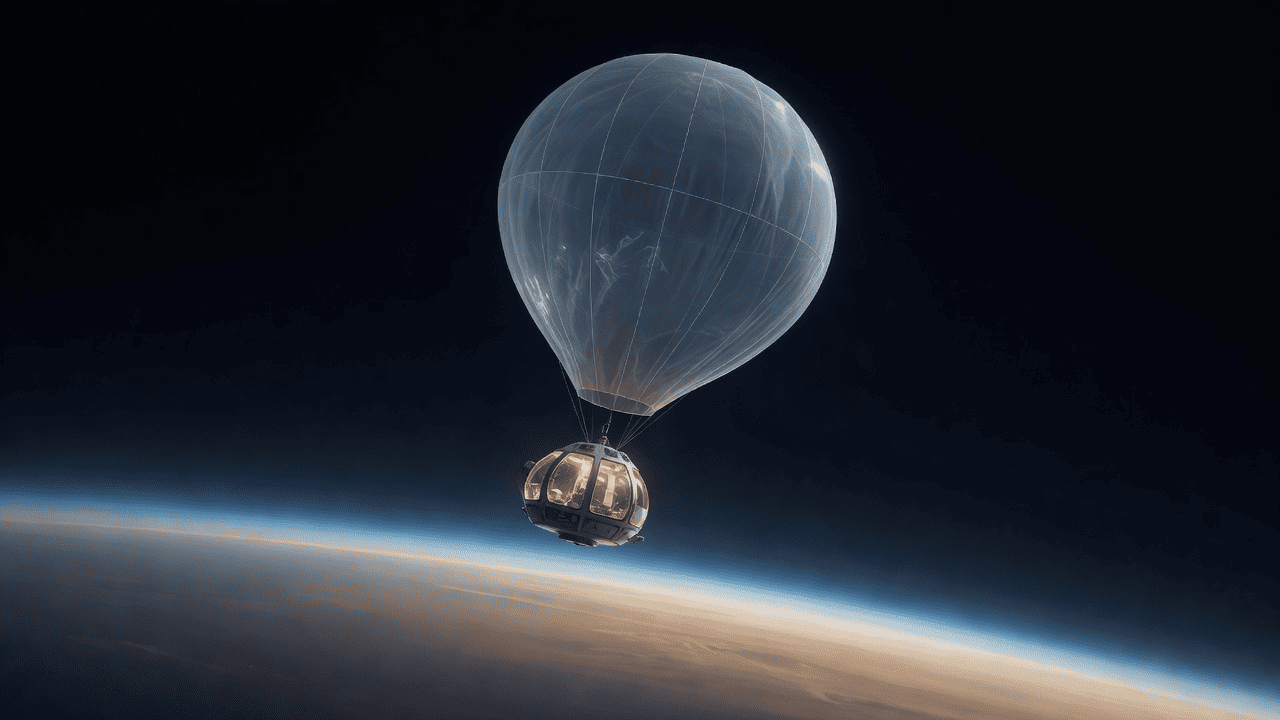
Rockets get all the headlines. The roar, the G-forces, the footage of billionaires floating in zero gravity for three breathless minutes — it's hard to compete with that. But a quieter, slower, and arguably more beautiful category of near-space travel has been building in the background, and it's starting to demand attention. Space balloon rides let you drift to the edge of Earth's atmosphere over six unhurried hours, sipping champagne and watching the planet curve below you. No training camp. No pressure suit. No countdown clock anxiety.
The question most people have — after "wait, is this real?" — is what it actually costs, who the companies are, and whether it's worth comparing to a rocket flight at all. Let's get into it.
What Is a Space Balloon Ride, Really?
Before you book anything, the terminology needs to be straight. "Space balloon ride" is a marketing-friendly phrase for what's technically called a stratospheric balloon flight — and that distinction matters.
The stratosphere sits roughly 12 to 50 kilometers above Earth. Despite being marketed as spacecraft and considered as such by the Federal Aviation Administration, these vehicles reach an apogee of about 30 km, which falls well short of the 100 km Kármán line — the conventional definition of space. So no, you're not technically going to space. You're going to the stratosphere. And that's not a downgrade — it's just an honest description of something extraordinary.
At 100,000 feet, the balloon ride takes people high enough to see the curve of the Earth against the blackness of space and the thin blue line of our atmosphere. That's the view astronauts describe changing their entire worldview — what researchers call the overview effect. It's a view that often shifts the perspectives of astronauts and space tourists who've been in space.
Here's the key difference from rockets: compared to rocket-powered space tourism, the physical sensation passengers experience on a stratospheric balloon ride is more comparable to being on an airplane. Passengers will not experience weightlessness. There are no G-forces on the way up, no violent reentry on the way down. It's a six-hour journey. You travel at 12 miles an hour, and the ascent is a very calm two-hour climb before spending two hours at 100,000 feet.
Think of it as the difference between a sprint and a stroll. Rockets sprint. Balloons stroll — and give you time to actually look around.
The Companies Offering Space Balloon Rides
This is still a small field. A handful of serious players exist, each with different approaches, price points, and levels of operational readiness.
Space Perspective
Space Perspective is a private American aerospace company building crewed high-altitude balloons for near-space tourism, developing Spaceship Neptune — a pressurized gondola lofted by a large hydrogen high-altitude balloon. Founded by aerospace entrepreneurs Jane Poynter and Taber MacCallum in 2019 with the stated goal of helping more people see Earth from its upper atmosphere, the company became the most talked-about name in stratospheric tourism.
The spherical carbon-composite gondola measures 16 feet in diameter and provides pressurized volume for up to eight passengers and one captain, lined with a thin UV-reflective coating and featuring fifteen 52-inch windows.
In September 2024, the company completed a full flight profile of its uncrewed Spaceship Neptune-Excelsior test vehicle, launching from Marine Spaceport MS Voyager off the coast of St. Petersburg, Florida. Over the six-hour test journey, the spacecraft reached its peak altitude of 100,000 feet — the highest-ever commercial balloon flight — before performing a controlled descent and splashdown.
The company hit turbulence in early 2025. Space Perspective was in financial turmoil from January 2025, resulting in the organization being acquired in July 2025 by competitor Eos X Space, a balloon flight company based in Spain. Eos X Space has said that Space Perspective will "operate with full autonomy, under U.S. leadership and corporate structure." It is rebooting under new ownership toward a first crewed flight, with $125,000 as its published fare.
World View
Arizona-based World View takes a different approach — and a lower price point. Ticket prices for a World View flight start at $50,000 per seat. The Explorer Space Capsule will host eight passengers and two crew for flights lasting 6 to 12 hours, giving people a view of the Earth the company argues resembles that seen from space. Flexible financing options are available.
What makes World View genuinely distinct is its launch strategy. Rather than splashing down in the ocean, the capsule deploys a patented parafoil system and separates from the balloon, gliding to a soft landing with gear that absorbs and deflects impact. And the company has plans for seven spaceports opening between 2024 and 2027, located at the Grand Canyon, Great Barrier Reef, Pyramids of Giza, Great Wall of China, Serengeti in Kenya, Amazonia in Brazil, and Aurora Borealis in Norway.
Viewing the Serengeti from 100,000 feet isn't a gimmick — it's genuinely one of the more compelling experiences in commercial aviation, let alone near-space travel.
Zephalto and Others
France-based Zephalto is also developing stratospheric balloon tourism, alongside Space Perspective and World View, aiming to hoist tourists to the stratosphere using pressurized capsules and massive gas-filled balloons. Zephalto's tickets run around $184,000 per seat — the most expensive of the three — with an emphasis on the fine-dining, high-design aesthetic that French luxury travel does well.
Companies like Space Perspective, Zero 2 Infinity, and World View all plan to use stratospheric balloons to fly customers in pressurized capsules to the edge of space. The field is still forming, and some names will consolidate or disappear before the first commercial passenger ever boards a capsule.
Space Balloon Ride Costs: A Realistic Breakdown
Here's what the pricing landscape actually looks like right now:
- World View: The six-to-eight-hour experience costs $50,000 per seat. The company is currently accepting $500 deposits, with flexible financing available.
- Space Perspective: Tickets are priced at $125,000 per person, with the company currently rebooting under new ownership after its 2025 acquisition.
- Zephalto: Around $184,000 per seat, with a more exclusive, curated offering.
To put these in context: World View sells rides for $50,000 per seat — about one-ninth of the price of a spaceflight ticket with Virgin Galactic. And compared to the orbital end of the market — Axiom Space is selling private missions to the International Space Station at approximately $55 million per seat — a balloon ride starts to look like a bargain.
That framing matters. "Affordable" in near-space tourism is always relative. But $50,000 is closer to a luxury safari or a custom European river cruise than to a rocket mission. The customer overlap is real.
One thing worth noting: the global space tourism market hit $747.1 million in 2023, and is projected to reach around $5 billion by 2034. The stratospheric balloon segment is a fraction of that today — but as the most accessible and least physically demanding segment, it could grow faster than anyone expects.
The Experience: What Actually Happens on a Space Balloon Flight
Imagine booking a first-class overnight flight, except instead of arriving somewhere, you arrive at the edge of the atmosphere and spend two hours watching the planet below you. That's roughly the analogy — and it undersells it, but it captures the vibe.
The space balloon gradually ascends for two hours at 12 miles per hour, glides at its peak altitude for two hours, then spends the final hours gradually descending. Throughout the journey, guests enjoy reclining seats, champagne, and a bathroom.
According to Space Perspective, the trip will offer Wi-Fi, a world-class culinary program, plush safety seating, luxury amenities, and panoramic views from above most of Earth's atmosphere. No special training is required; the pre-flight safety briefing is expected to be similar to that delivered by flight attendants today.
The landing is one of the more dramatic-sounding parts. The Space Perspective capsule splashes down in the ocean, where eight customers and one pilot will be scooped up by a ship, similar to how NASA and SpaceX retrieve their crewed capsules. World View, by contrast, uses its parafoil system for a dry-land touchdown near the launch site.
The one thing you won't get? Weightlessness. While a balloon ride is significantly cheaper and may appeal to more risk-averse customers, passengers won't go quite as high into the atmosphere and won't experience any weightlessness. If floating is the dream, a rocket flight — Blue Origin's New Shepard or Virgin Galactic's coming Delta-class — remains the only commercial option for that sensation.
Who Can Actually Fly — The Medical Bar Is Low
This is where space balloon rides genuinely separate themselves from every other near-space option.
The beauty of balloon-borne flight is you don't have to be in supreme physical health to do it. As Zephalto's founder put it: "We don't need any physical requirements to board the balloon. If you can board a standard plane, you can board the balloon."
Contrast that with suborbital rockets, which — while considerably more accessible than orbital missions — still require short-duration G-force training and a more thorough medical screening. What rocket operators are looking for are acute or uncontrolled conditions that could become dangerous under G-loading in a setting where emergency medical care is impossible, such as serious uncontrolled cardiovascular disease, recent cardiac surgery, and certain respiratory conditions.
A balloon ride involves none of that G-loading. The ascent is gentle. The capsule is pressurized and climate controlled. Passengers will feel like they are in an extremely high-altitude lounge looking down on the Earth. This makes stratospheric balloon tourism meaningful for older travelers, people with mobility considerations, or anyone who has ever wanted to experience that view but quietly worried they weren't physically up to a rocket launch.
The balloon technology itself is proven. The same type of balloon technology has been used by NASA more than 1,000 times. These aren't novel materials or untested engineering concepts — the lift mechanism is decades old. What's new is the passenger capsule and the commercial model wrapped around it.
Space Balloon vs. Rocket: The Honest Comparison
People keep framing these as competitors. They're not, really — they're completely different products.
A rocket flight to suborbital space is an intense, brief, physically demanding experience. Blue Origin's entire suborbital flight lasts about 11 minutes. You'll experience G-forces on ascent, true weightlessness for a few minutes at apogee, and a rapid descent. You cross the Kármán line. You can say, by any international definition, that you went to space.
A space balloon ride is the opposite of all that. Hours, not minutes. Calm, not thrilling. Earth-gazing, not weightlessness. You don't cross the Kármán line. But you spend two unhurried hours watching the planet below you from 100,000 feet, above 99% of Earth's atmosphere, with a drink in hand and no countdown clock in your head.
The price gap mirrors the experience gap. Rocket suborbital flights run from hundreds of thousands to millions depending on the operator. Virgin Galactic has reopened ticket sales for its next-generation Delta-class spaceplane at $750,000 per seat. A World View balloon seat at $50,000 isn't in the same category — it's a different product at a different price for a different kind of person.
The right question isn't "which is better?" It's "what do you actually want to feel?"
If near-space tourism continues its current trajectory, the balloon segment may end up being the one that reaches the most people — not because it's the most dramatic option, but because it's the most accessible. A 90-year-old with a bad heart who has stared at the stars for eight decades deserves that view as much as anyone. A balloon might be the only vehicle that can give it to them.
Would you rather spend six hours watching the Earth breathe, or eleven minutes punching through the atmosphere? Both are valid answers. But it's worth being honest about which one you're actually buying before you sign a check with that many zeros.